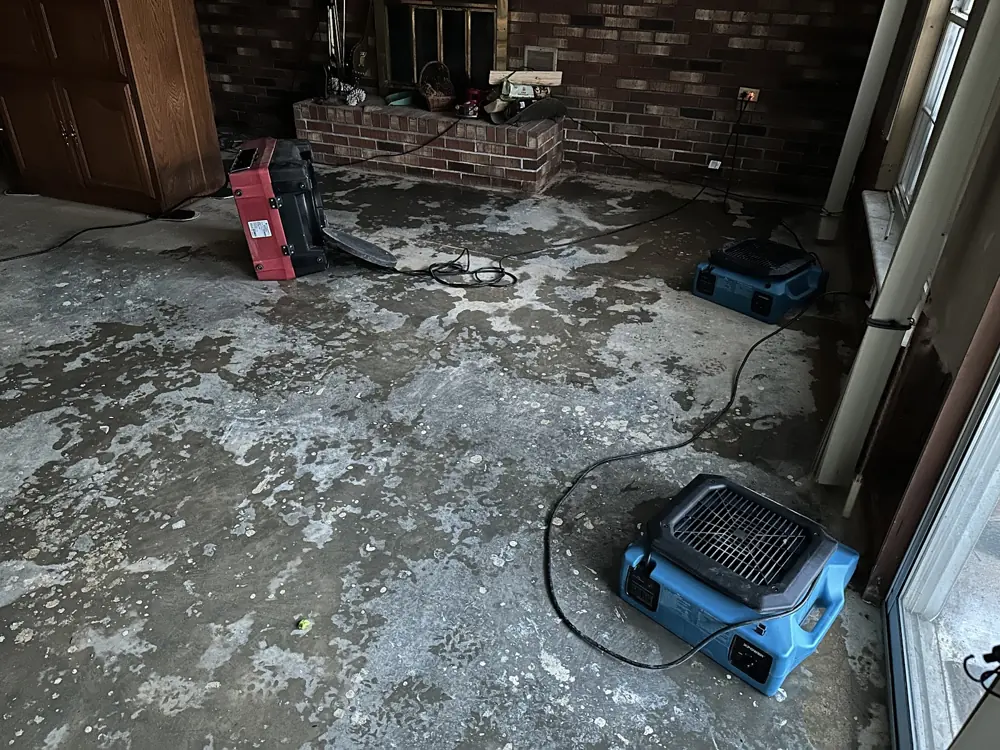
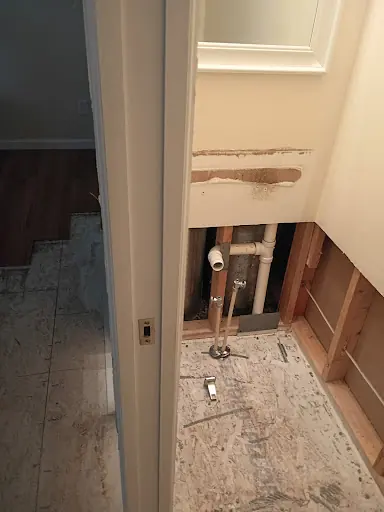
Garages often sit at the lowest point of a Vista property, which means storm runoff, a burst line, or a failing water heater tends to end up there first. Crews respond around the clock to extract water and protect stored belongings and flooring.

A crew typically arrives in about an hour to identify the source, whether storm runoff, a burst line, or a failed water heater.
Pumps and extraction equipment remove standing water from the garage floor as quickly as possible to limit exposure time for stored items.
Stored belongings, drywall, and insulation are assessed, with unsalvageable materials removed and valuable items documented.
Air movers and dehumidifiers dry the garage space and any adjoining interior areas, with moisture readings logged until verified dry.

While help is on the way, these first steps, done only where it is safe, limit the damage and protect the insurance claim.
Shut the supply off at the source, or close the home's main valve if the source is not obvious. Stopping the flow limits the damage more than anything else.
Switch off electricity to the affected area, but only if the breaker can be reached without standing in or touching the water.
Get a crew dispatched right away. The sooner extraction and drying begin, the more flooring, drywall, and belongings can be saved.
Take photos and a short video of the water and the affected rooms before anything is moved, so the insurance claim starts strong.
Garage water damage cleanup in Vista typically runs from about $400 to $2,500, depending on the source and how much drywall, insulation, or stored contents were affected. Storm runoff caught quickly with only the concrete floor affected sits at the low end. A failed water heater that ran for hours and reached garage drywall or an adjoining interior room runs higher because that material often needs to be opened and dried or replaced. Repairing a leaking appliance is separate work handled by a qualified plumber, and moisture documentation is provided for the homeowner's insurance carrier.
Crews reach Vista and inland North County San Diego fast, from Downtown Vista, Shadowridge, and Rancho Buena Vista to Oceanside, San Marcos, Carlsbad, Escondido, Bonsall, and Fallbrook. See the full list on the areas served across Vista page.
See all areas servedEvery loss is photographed, measured, and logged from the first visit, so the paperwork holds up with the insurance carrier.
Technicians follow recognized IICRC drying standards and prove it with daily moisture readings on Vista homes, not guesswork.
Emergency dispatch any hour of the day or night, with a real crew on the way across inland North County, not a callback in the morning.
A real crew dispatched any hour, not a callback in the morning.
Trained technicians following recognized IICRC drying standards.
Truck-mounted, portable, and submersible for any size loss.
The loss is documented and billed to the carrier directly.
Garages often sit at or below the level of the driveway and yard, so storm runoff naturally flows toward them, and many also house appliances like water heaters that can fail and release large amounts of water at once.
It depends on the material and how long they sat in water. Non-porous items often clean up well, while cardboard boxes, some furniture, and paper goods that were submerged for an extended period frequently cannot be saved.
Only if the drywall was saturated for long enough to lose structural integrity or if it was exposed to contaminated water. Drywall exposed to clean water and dried quickly can sometimes be saved.
Storm runoff from driveways and yards during winter atmospheric-river storms, along with garage-mounted water heater failures, are the most common causes seen locally.
Sudden flooding from a storm or an appliance failure is often covered, though coverage for storm-related flooding can depend on the specific policy. Documentation of the cause and extent supports whichever claim applies.
Vista crews are on call 24 hours a day, local and fast, and can be on the way within the hour.
Call (760) 334-5108